
Climate change, biodiversity loss and the transgression of planetary boundaries are not simply scientific, technological or policy challenges. They are leadership challenges. Organisations have enormous capacity to influence both the causes of ecological degradation and the transition towards more sustainable, regenerative and nature-positive forms of economic activity. Climate Change Leadership (CCL) therefore asks a fundamental question: what forms of leadership enable organisations to operate and flourish within ecological limits?
The Failure of conventional leadership
Conventional leadership models were largely developed for a world in which organisational performance could be evaluated independently of the ecological systems on which organisations depend. Many continue to emphasise heroic individual agency, hierarchical authority, short-term performance and relatively context-neutral measures of effectiveness. These assumptions are increasingly inadequate in the face of climate change, biodiversity loss and other complex, interdependent and morally intense challenges. CCL emerged in response to three core premises: that much contemporary climate and biospheric degradation is anthropogenic; that organisations are responsible for a significant component of this impact through their products, processes and purchasing; and that organisational leadership has frequently failed to mitigate these impacts at the scale required. Effective leadership can therefore no longer be judged solely by whether it delivers organisational goals. The purpose, consequences and ecological context of those goals also matter. Climate and biodiversity challenges also expose the limits of leader-centric and compliance-oriented approaches. They require leaders to work with complexity, uncertainty, competing values, interdependence and long time horizons. CCL therefore shifts attention from the exceptional individual leader towards leadership as a distributed and multi-level process embedded in teams, organisations and wider ecological systems.
From conventional leadership to Climate Change Leadership
CCL has evolved by drawing on several strands of leadership theory, retaining what is useful while extending them for the age of sustainability. These approaches can be understood as part of a progression from conventional leadership towards more ecologically embedded and post-conventional forms of leadership.
Ethical and responsible leadership
Ethical and responsible leadership provide important transitional foundations for CCL. Ethical leadership places constraints on harmful action, promotes norms for responsible conduct and emphasises the cultivation of virtues that support good judgement. In the context of CCL, this ethical frame extends beyond immediate organisational stakeholders to include the biosphere, future generations and the long-term consequences of organisational decisions. Responsible leadership similarly broadens the field of accountability. Rather than treating sustainability as a peripheral corporate responsibility activity, it asks organisations to lead with purpose, include a wider set of stakeholders and embed environmental responsibility across strategy, supply chains, customers and partnerships. More recent CCL thinking strengthens this transition through bioethical reasoning, stewardship and the development of self-transcending values.
Environmental, green and sustainability leadership
Environmental and green leadership made environmental outcomes an explicit concern of leadership and helped challenge the assumption that leadership resides in a single formal role. Eco-leadership, in particular, emphasised connectivity, interdependence, systemic ethics and the need to question economic assumptions such as perpetual growth and the treatment of ecological damage as an externality. Sustainability leadership developed this further by placing organisational purpose and performance within a wider ecological and social context. It challenged narrow stakeholder models, context-free leadership and purely hierarchical approaches. These contributions remain important, but CCL now makes a further distinction between weak and strong sustainability. Leadership that merely improves efficiency or balances environmental concerns against existing business priorities may still leave the underlying model unchanged. Stronger forms of sustainability require organisations to align purpose, strategy and governance with ecological limits.
From heroic to distributed leadership
Shared and distributed approaches are particularly important for CCL because climate change is too complex to be addressed through the capability of a small number of senior leaders. Leadership talent is diffuse, developable and often enacted through teams, relationships and informal influence rather than hierarchy alone. This moves CCL from a focus on leaders to a focus on leadership acts. At the team level, shared purpose, complementary capability, ecological norms and distributed leadership provide a bridge between individual leadership capacity and organisational impact. The implication is not that formal leadership becomes irrelevant, but that effective climate leadership depends on collective capacity as well as individual judgement.
Ecological, restorative and regenerative leadership
Ecological leadership makes explicit what conventional leadership often overlooks: organisations are embedded within living systems and are constrained by the conditions required for those systems to remain viable. Restorative and regenerative approaches extend the ambition from reducing harm towards repairing, renewing and contributing positively to the ecological and social systems on which organisations depend. This is an important progression in CCL. The goal is no longer simply to make existing forms of business less damaging, but to encourage forms of leadership capable of supporting strong sustainability, resilience, restoration and ecosystem-wide flourishing.
Climate Change Leadership integrates these traditions but extends beyond them. It is best understood as an umbrella theory of post-conventional leadership for organisations responding to climate change, biodiversity loss and wider ecological disruption. Its defining contribution is to connect leadership capacity with ecological context, organisational transformation and meaningful sustainability outcomes.
Leadership across micro, meso and macro levels
Individual leadership capacity is necessary but insufficient. CCL has therefore evolved from a predominantly micro-level model towards a multi-level framework in which leadership operates across individuals, teams and organisations. At the micro level, CCL concerns the capacities and judgement of individual leaders. At the meso level, it concerns the relational dynamics, structures and leadership processes of teams. At the macro level, it concerns the systems, structures, culture, strategy and governance of the organisation itself. This multi-level perspective recognises that strong sustainability cannot be achieved through individual capability alone. It requires enduring changes to organisational purpose, strategy, culture and governance.
Leadership for planetary flourishing
The direction of travel in CCL is therefore broader than conventional organisational performance. The evolution is from leader-centric to multi-level leadership, hierarchical to distributed leadership, anthropocentric to ecocentric framing, carbon-centric to biodiversity-aware leadership, weak to strong sustainability, and from reducing harm towards restoration, regeneration and ecosystem-wide flourishing. From this perspective, the ultimate test of leadership is not simply whether an organisation performs well within existing market conditions, but whether its purpose, decisions and impacts contribute to a viable and flourishing future within planetary boundaries.
The Climate Change Leadership Framework
The Handbook of Climate Change Leadership in Organisations organises the development of CCL around four connected concepts: Foundations, Transitions, Progressions and Actions. Together they describe the intellectual foundations of the field, the repurposing of established leadership models, the emergence of post-conventional approaches, and the translation of leadership capability into purposeful action.
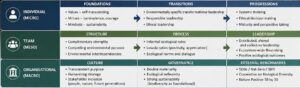
This framework provides a bridge between theory and practice. It positions CCL not simply as a set of leadership attributes, but as a developmental and applied model for building the individual and collective capability required to respond to climate and ecological challenges.